
The first time a mathematical proof completely broke my brain, it didn’t happen in the math department. It happened when I read Spinoza’s proof that God exists.
I was a freshman, and it wasn’t even on the syllabus. But I’d missed the class, so I picked up the Ethics from the library. It’s a short book, built geometrically - it starts from axioms, uses them to prove propositions, and stacks logical claims that way. Then, on page 11, this shows up:
“Whatever is, is in God, and nothing can be, or be conceived without God.”
[follows from Proposition 14 and Definition 3]
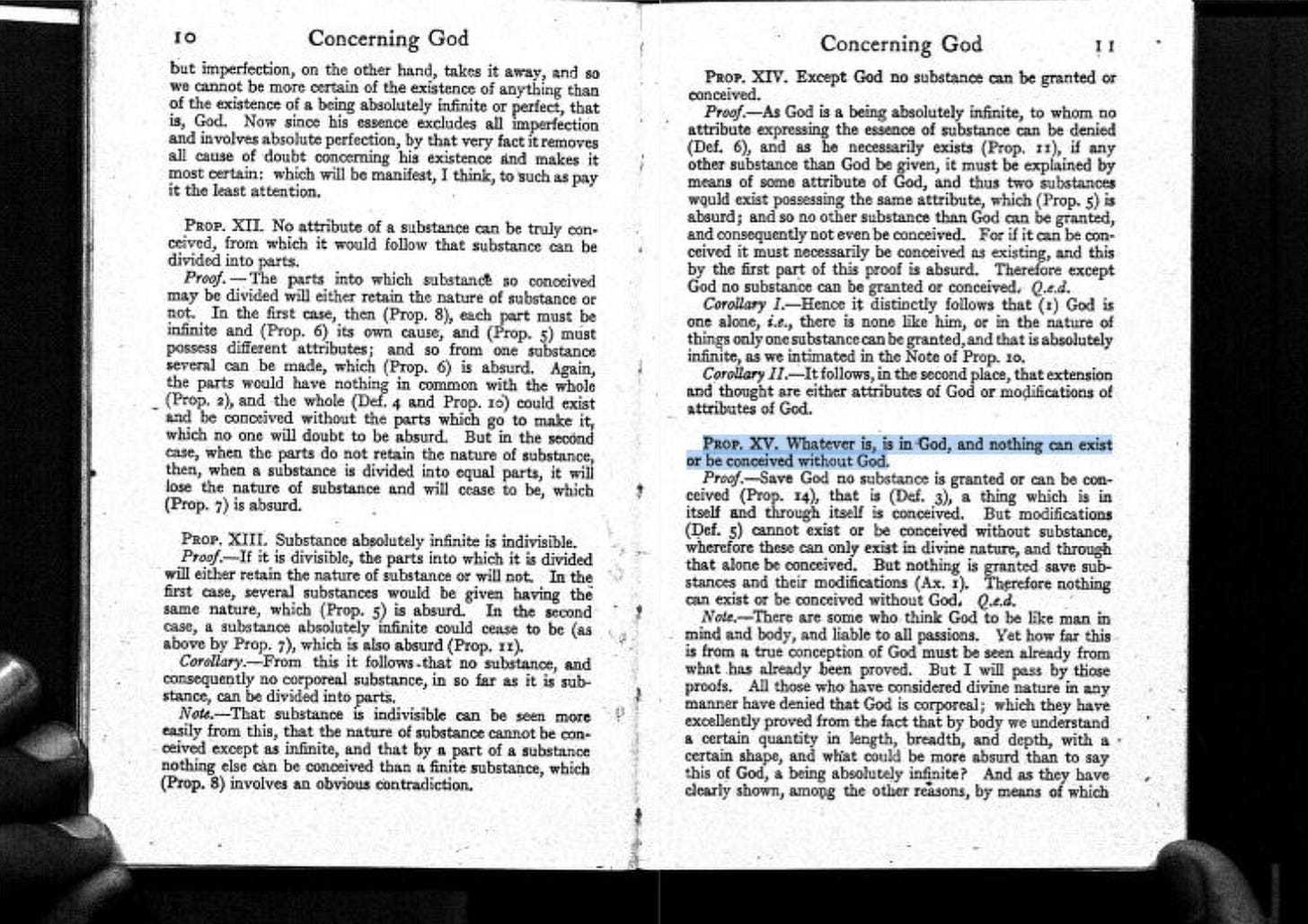
Fuck. Besides the fact the claim itself is wild - there’s no way to disagree. The proof pulls you there.
Last week Terence Tao, one of the greatest mathematicians of our time, published a wonderful piece called Mathematics in the Age of AI, containing mathematical-philosophical writing so elegant it reminded me of the Ethics. An amazing example of using mathematical rigor to say something meaningful and interesting about the world around us.
The frantic race toward a generic intelligence meant to replace all of our knowledge work confronts us with basic ethical questions in every field - what are our goals, our objectives, our values, including the ones below the surface that we’ve never said out loud? What are our implicit assumptions? How do you formalize, in a formula, what success is? And how do you verify that the metric you defined for success is actually the right metric?
In short, his argument goes like this: how do we define success in solving mathematical problems?
(1) If we define it as “solve as many open problems as possible,” we’re liable to get a great many wrong solutions. That’s Goodhart’s law - we optimized too hard of the measurement.
(2) If we define it as “solve as many open problems as possible and verify that the solution is correct,” we’re liable to get solutions we don’t understand.
(3) So we’d better define it as “solve as many open problems as possible, verify the solution is correct, and make sure they can be communicated to the mathematical community in a way it can understand.” Great — except that for a mathematical proof to contribute to the advancement of mathematics, it has to teach us something about how mathematics is done. Others have to digest it, and also accept it, and use it in their own work.
(4) Which means the goal becomes: “solve as many open problems as possible, verify the solution is correct, make sure they can be communicated clearly, and get them accepted and digested by the mathematical community” - that is, become canonical, genuinely absorbed into the way mathematics is done. Which is of course a much slower, longer, more delicate process, harder to evaluate.
We don’t just want to solve the problems. We want to let the road we traveled change us.
Academic institutions were born into a world of scarcity of proofs, and when we reach abundance they’re going to struggle badly. Anyone who has submitted a paper to a major scientific conference in the past year knows it’s not unusual to see 50,000 (!) submissions.
The reason slop is so hard for us is that it forces us - as a society and as individuals - to go deep and re-examine what’s good and what’s bad, at a far higher rate than we’re used to.
Toward the end of the Ethics, Spinoza tries to help us tell them apart, and makes an incredible moral claim:
“We know nothing to be certainly good or evil, save such things as really conduce to understanding, or such as are able to hinder us from understanding.”
Understanding is the only thing we know with certainty to be good. Everything else is good only if it serves understanding or follows from it.
Meaning - a pile of correct proofs that nobody understands, and apps that took us a moment to generate and another moment to forget, and blog posts made of short sentences: none of them are good, because they don’t move us forward as humanity.
Good is only what increases our power to act in the world, what changes the way we ourselves think and work and create. It is the motion itself.
For Spinoza, “more good” doesn’t mean being more moral - it means being more existent. Simply, to be more.
Wow. What a lesson.
P.S. - one of my favorite stories is how, at 24, the Portuguese Jewish community issued a severe cherem (a ban) against him, over the “abominable heresies which he practised and taught” in his conceptions of what God is.
When he got the news, he replied: “All the better. It forces me to do nothing that I would not have done of my own accord, had I not been afraid of a scandal.”
All the better. What an icon.